Digital concert programme
Quartet in Residence: Opus13
Tuesday 26 May 2026, 7.30pm
The Venue at Leeds Conservatoire
Joseph Haydn Quartet Op 74, No 1
Knut Vaage Bumerang
Interval of twenty minutes
Franz Schubert Quartet No 14 (Death and the Maiden)
Thanks to our continuing partnership with Wigmore Hall String Quartet Competition, every three years we bring a new world-class string quartet to Leeds for nine exciting performances. In April 2025 we went to Wigmore Hall for the finals of the competition and selected Opus13 to be our next Quartet in Residence. We welcome you this evening to the first recital of the quartet’s residency and look forward to getting to know them with you over the next three years.
Leeds International Concert Season
We are very much looking forward to starting our residency in Leeds and getting to know the audience at The Venue. Following the fantastic Leonkoro Quartet, we know we have big shoes to fill!
For our first season in Leeds, we’ve put together three programmes consisting of pieces that mean a lot to us and are important parts of our identity. As a quartet, we love performing the great string quartet canon, and we’re equally passionate about bringing Nordic music – both classical and contemporary – to audiences abroad. This is reflected in our programming of Knut Vaage’s Bumerang this evening.
Opus13
Joseph Haydn (1732-1809)
String Quartet in C major, Op 74, No 1
Allegro moderato
Andantino grazioso
Menuetto: Allegretto
Finale: Presto
Haydn's set of three quartets published as Opus 74 dates from 1793 and is contemporary with his symphonies Nos 99-101. The first of the group begins with a grand introductory gesture – only two chords, but the rich scoring is an indicator for the quartet as a whole. Haydn's occasional use of monothematicism (making the same theme serve as both first and second subjects) is evident here in an opening theme inflected with chromatic notes. Other transitional material creates considerable contrast. In the development Haydn immediately distorts his main theme with more chromatic notes and continues by travelling into adventurous keys. The recapitulation further exploits the main theme's potential with some canonic imitation, then a dramatic jump into A flat major. In the coda a powerful unison passage emphasises the grandeur of this wide-ranging movement.
The Andantino grazioso is charming and graceful while accommodating many delightful subtleties. The second theme, beginning at bar 14, initially sounds as relaxed as Rossini, but in the latter half of the movement Haydn ventures into unexpected keys, even, very briefly, the distant C sharp minor.
The robust minuet, which surprisingly drops into A flat major at bar 15, has a suave trio section in A major. Its first notes are identical to those which began the minuet, but the character of this trio is utterly different.
Rather than a rondo, the brilliant finale is another sonata-form movement. Again, as in the minuet and trio, Haydn effortlessly transforms the character of the opening theme - here immediately repeating it staccato. Later, following a paused cadence, he begins a little counterpoint, then subsequently a distinctly rustic flavour makes itself felt – on two occasions above a drone bass evoking bagpipes. With several dozen string quartets behind him, Haydn is a complete master of the genre, as this Opus 74, No 1 comprehensively demonstrates.
Knut Vaage (born 1961)
Bumerang, Op 13
The Norwegian composer Knut Vaage attended the Grieg Academy in Bergen, where he studied piano and composition. Bergen is also where he lives and composes. His composition list includes several operas, more than a dozen works for orchestra or solo instrument(s) with orchestra, much chamber music for many diverse combinations, about a dozen keyboard works and numerous vocal or choral compositions. Works for big band, wind ensemble and brass band also feature, while Vaage has participated in projects aimed at performance by the younger generation and by amateur musicians.
Vaage has written: “The piece Bumerang is made up of contrasting sections that keep turning back [hence the title], albeit never exactly to the same starting point. These various changes incite a restless expression. Another element of unrest is the use of different kinds of tremolo throughout most of the piece. Bumerang offers contrasting textures, both between the instruments and in the juxtaposition of the work's sections. The string quartet is a kind of ensemble that, from the Classical era to our time, has been used in order to try out new musical tools. In Bumerang I wish to get to grips with some of the special properties germane to string instruments. This takes place through a process that can perhaps be defined as an exploration of the instruments' anatomy.” Bumerang was commissioned by the Nidaros String Quartet, which gave the premiere in 2011.
Franz Schubert (1797-1828)
String Quartet in D minor, D 810 (Death and the Maiden)
Allegro
Andante con moto
Scherzo: Allegro molto
Presto
Schubert composed more than a dozen string quartets, of which the three late masterpieces in A minor, D minor and G major, together with the Quartet Movement in C minor, are mainstays of the repertoire. The D minor Quartet (1824) includes a set of variations based on material which Schubert adapted from his song Death and the Maiden, but he himself never gave that title to this quartet or to any other piece of “absolute” (ie non-programmatic) music except his Fourth Symphony (Tragic). Seriously ill when he composed the D minor Quartet, Schubert may well have been privately preoccupied with death, but no great composer writing a 4-movement work would neglect contrast of mood and overall balance.
The quartet begins arrestingly with two short phrases, each one driven home by a triplet, a rhythmic unit which proves to be pervasive. There follows a hushed, hesitant answer, before momentum is established and the triplet figure becomes increasingly predominant. An Italianate second theme, again underpinned by triplets, is introduced, but Schubert soon subjects this melody – surprisingly – to severe contrapuntal treatment. One feature of the powerful development section is the combination of the second subject with triplet-based rhythms from the first subject. The movement ends pianissimo, as eloquent first violin phrases dissolve into muttered triplets.
The slow-movement theme, freely adapted from the song Death and the Maiden, is more memorable harmonically than melodically, its strong bass line providing ideal material for variations. Having introduced the theme pianissimo, Schubert adds elegant embellishments in the first two variations, but the mood is dramatically intensified in Variation 3, dominated by a robust, obsessive rhythm and emphasised by sforzando markings. The fourth variation (in G major, pianissimo) is suavely lyrical, with an exquisite first violin part, but in the final variation (G minor) the cello becomes increasingly insistent and wide-ranging in a magnificently ominous transformation of the second half of the theme.
The grim, resolute scherzo, its theme originating in the sixth of Schubert's German Dances D 790, is characterised by syncopation across the bar-lines (with many forzando markings), but contrast is created by the warmth and grace of the D major trio section. The juxtaposition of this heavenly trio section with the severity of the scherzo is typical of many works from Schubert's last few years.
The tarantella-style finale again typifies Schubert's persistent treatment of rhythm. Although this is a characteristic he shares with Beethoven, the two composers are both utterly individual. Initially the dynamic is piano, but the subsequent alternations of loud and soft are unsettling. Having temporarily exhausted itself, this taut energy gives way to a broad new theme, but the tarantella rhythm soon returns. For the coda the tempo is increased to a breathless Prestissimo and a big final crescendo ends this tremendous work.
© Philip Borg-Wheeler
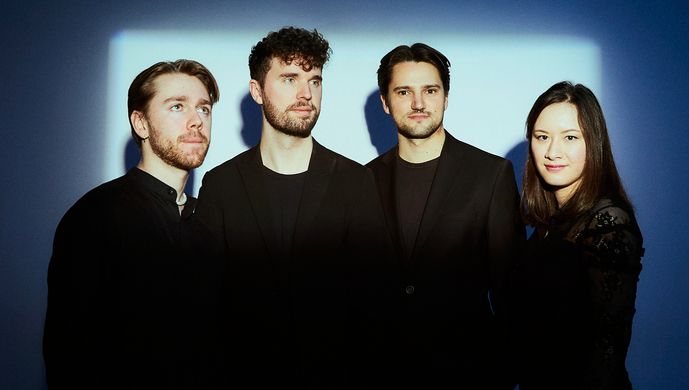
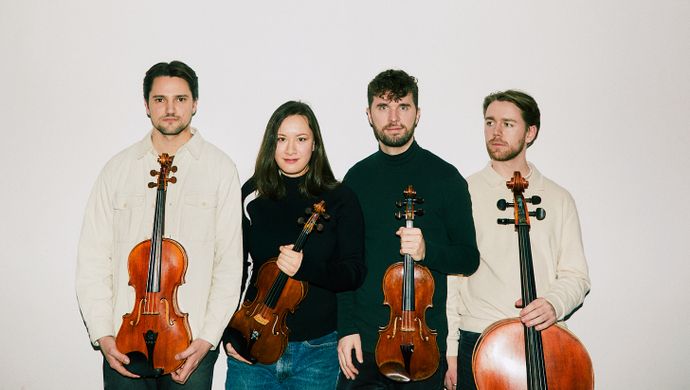
Opus13
Sonoko Miriam Welde – violin
Edvard Erdal – violin
Albin Uusijärvi – viola
Daniel Thorell - cello
“This was a performance of a profundity and kaleidoscopic colour that would have been astounding from any ensemble, let alone a young one still making itself known.” (Charlotte Gardner, Gramophone)
First Prize winners at both the 2025 Wigmore Hall International String Quartet Competition and the Bordeaux International String Quartet Competition, Opus13 is rapidly building a reputation on the international chamber music scene.
Named after Mendelssohn’s youthful and passionate A Minor Quartet, Op 13 - the first piece they ever played together - the quartet was formed in Oslo in 2014 by four teenagers eager to dive into the world of string quartets. Opus13 comprises Norwegian violinists Sonoko Miriam Welde and Edvard Erdal, violist Albin Uusijärvi and cellist Daniel Thorell, both from Sweden.
In addition to performing the core string quartet repertoire by composers such as Mozart, Bartók, and Schubert, Opus13 are passionate ambassadors of Nordic classical and contemporary music, frequently programming works by Grieg, Stenhammar, Tarrodi, Byström, and Fagerlund. They also enjoy genre-crossing collaborations, having performed with Norwegian folk and popular music artists including Gjermund Larsen Trio, Sissel Kyrkjebø, and Sver.
Upcoming debuts include performances at Concertgebouw Amsterdam, Wigmore Hall London, Laeiszhalle Hamburg, Essen Philharmonie, Rotterdam De Doelen and Stockholm Konserthus, as well as festival projects at the Baltic Sea, Bergen, Bologna, Cheltenham and Banff Festivals. Opus13 returns to South Korea for a series of performances and make their debut tour of Japan including performances in Osaka, Yokohama and Tokyo.
Opus13 collaborates with leading musicians such as Janine Jansen, Leif-Ove Andsnes, Tabea Zimmermann and Anne Sofie von Otter. Their musical development has been shaped by ongoing mentorships with Bjørg Lewis and Berit Cardas of the Vertavo Quartet and Tim Frederiksen. From 2025 the quartet has also studied with Prof Oliver Wille (Kuss Quartett).
Opus13 are the founders and artistic directors of Vinterspill på Lillehammer, an annual chamber music festival in Lillehammer, Norway.
The quartet performs on an exceptional set of instruments:
- Sonoko Miriam Welde, violin – Antonio Stradivari (1736), on loan from Anders Sveaas’ Charitable Fund
- Edvard Erdal, violin – Giovanni Battista Guadagnini (1751), on loan from Dextra Musica
- Albin Uusijärvi, viola – Christophe Landon (2008)
- Daniel Thorell, cello – Giuseppe & Antonio Gagliano (1772), on loan from the Järnåker Foundation